
An 84-inch sofa is exactly as long as a 5x7 rug.
So a rug that looks big in a store photo can end right at your sofa arms, with 0 inches to spare.
That’s why rug sizes for living room setups come down to 2 measurements: your sofa and your walls.
Below, you’ll get a size chart, the simple math for your own room and a tape test that takes 5 minutes.
Here’s where to start:
- Sofa, coffee table and 2 chairs in a normal room? Look at an 8x10 first.
- A long sofa, a sectional or a room of 12x15 or more points to a 9x12.
- Tight apartment with the sofa on a wall: a 6x9 usually does the job.
- For a big open room, size a 10x14 to the seating group.
Living Room Rug Size Chart
Most living rooms need an 8x10 or 9x12 rug, with a 6x9 for small rooms and a 10x14 for large or open ones. The right pick depends on the furniture first, then the room.
So use this chart to find the 1 or 2 sizes worth taping out. Each row shows a size, the smallest room that keeps an 18-inch border of bare floor, and the longest sofa it can hold with 8 inches showing past each end:
| Rug Size | In Inches | Room for 18-Inch Border | Longest Sofa |
|---|---|---|---|
| 5x7 | 60 x 84 | 8 x 10 ft | 68 in |
| 5x8 | 60 x 96 | 8 x 11 ft | 80 in |
| 6x9 | 72 x 108 | 9 x 12 ft | 92 in |
| 8x10 | 96 x 120 | 11 x 13 ft | 104 in |
| 9x12 | 108 x 144 | 12 x 15 ft | 128 in |
| 10x14 | 120 x 168 | 13 x 17 ft | 152 in |
| 12x15 | 144 x 180 | 15 x 18 ft | 164 in |
These numbers are plain arithmetic, so you can check any of them with a tape measure. The room column adds 3 feet to the rug’s length and width, and the sofa column takes 16 inches off its long side.
If your room falls between 2 rows, go bigger when both fit your furniture. Stores sell other standard rug sizes too, including runners and rounds, but these 7 are the ones to compare for a seating group.
How to Measure for a Living Room Rug
Measure your seating group first and your room second, because the rug belongs to the furniture and not the 4 walls. A room’s center is rarely where the sofa and chairs actually sit.
That one change in order solves most sizing mistakes.
Step 1: Measure the Seating Group
Start with the sofa, chairs and coffee table right where you use them. Write down the sofa width from arm to arm, then the distance from the front of the sofa to the front of the farthest chair.
Those 2 numbers are the smallest footprint your rug has to touch. If a chair sits 9 feet from the sofa, a 5-foot-deep rug can’t reach it.
Step 2: Add the Sofa Margin
Next, add a margin past each end of the sofa, and I’d aim for about 8 inches. Extra width past the arms looks planned, while stopping short makes the sofa look too big.
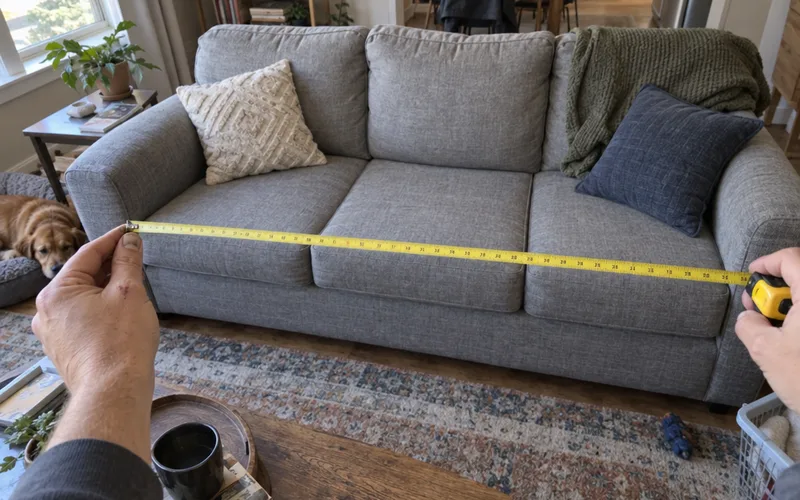
Say your sofa is 84 inches wide. Add 16 inches and you get 100 inches, so the long side needs to be at least 8 feet 4 inches.
A 5x8 falls short at 96 inches, but a 6x9 clears it at 108 inches. In other words, the sofa alone rules out the 2 smallest sizes on the chart.
Step 3: Check the Walls
Last, compare your pick with the room. Subtract the rug from the room on each side, divide by 2, and you have the border of floor that will show.
Say your room is 13 by 16 feet and you’re looking at an 8x10. That leaves 2.5 feet on one side and 3 feet on the other, so you could step up to a 9x12 and still keep 2 feet all around.
When a rug clears the sofa and leaves at least 1 foot at every wall, it fits. From there, your layout decides how far to size up.
Does a Rug Have to Go Under the Couch?
No, a rug doesn’t have to go under the couch, but in most rooms at least the front legs should sit on it. Interior designer Becki Owens wrote on the firm’s design blog in April 2024 that the front 2 legs of your sofa and main chairs belong on the rug at a minimum.
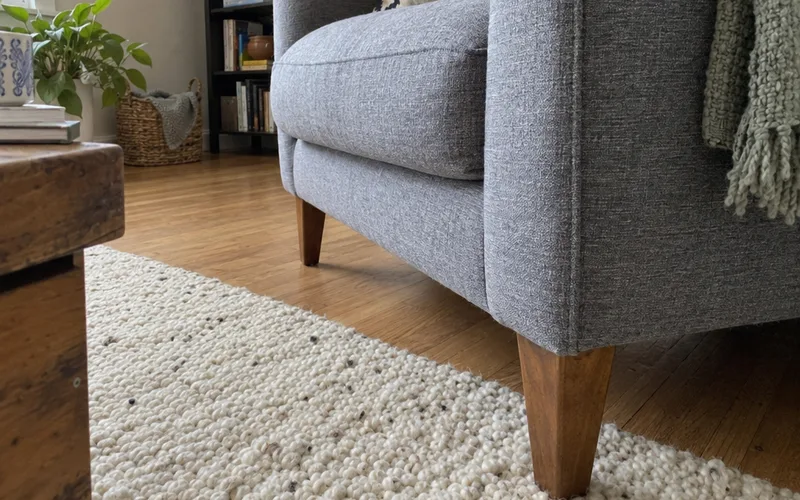
That rule ties everything together, so the seats read as 1 group. You have 3 ways to set it up, and each one needs a different size.
Front Legs on the Rug
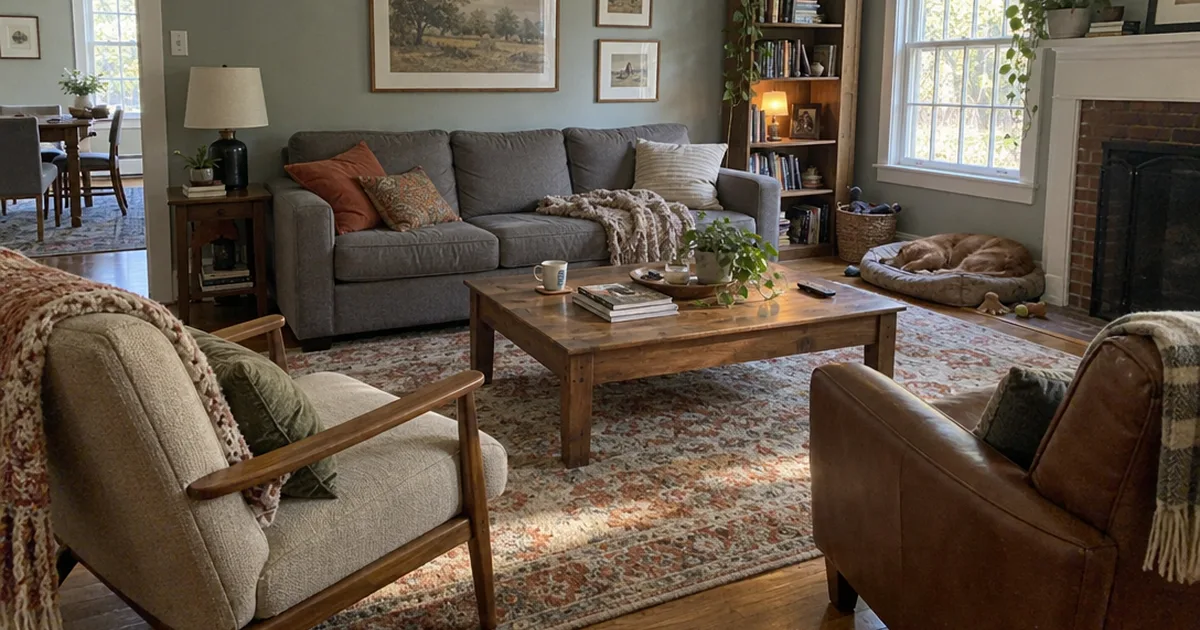
This layout is the default for most homes, and it’s where an 8x10 or 9x12 does its best work. The front legs of the sofa and chairs rest on the rug, while the back legs stay on the floor.
It works when the sofa sits against a wall, because the rug only has to reach just past the front legs. You also get more floor showing, which helps a smaller space feel open.
The catch is depth, so leave a few inches behind each front leg. Set a leg right at the edge and it can slip off the first time someone sits down.
All Legs on the Rug
Here, every leg of every seat sits on the rug, so it has to be larger than the whole seating group. A 9x12 can do this for a compact group, but a 10x14 is the more common fit.
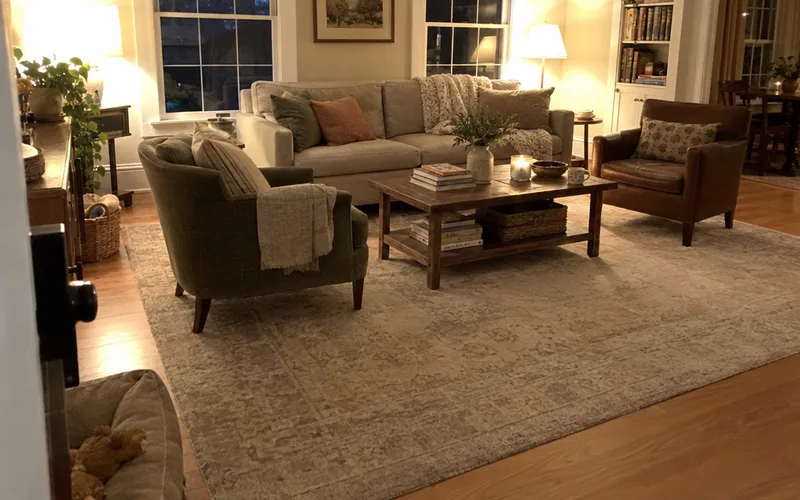
This layout makes sense when your seats float away from the walls. It gives a floating sofa something to sit on, so the group reads as 1 room inside the room.
Coffee Table Only
In this layout, only the coffee table sits on the rug, and the sofa and chairs stay off it. It suits tight rooms and small budgets, and a 5x7 or 5x8 will do it.
The trick is to keep it close to the sofa, just a few inches from its front legs. Leave more of a gap and it drifts away like an island in the middle of the floor.
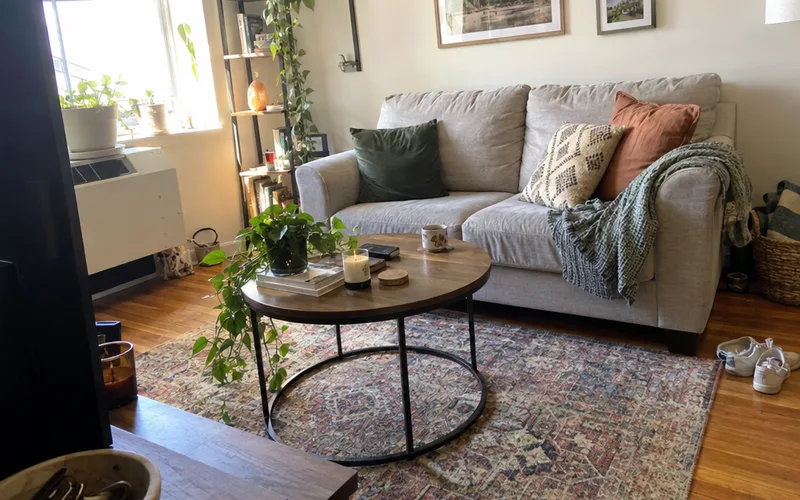
So pick front legs if you can, all legs if your furniture floats, and coffee table only if the room or budget forces it.
Is an 8x10 Rug Big Enough for a Living Room?
Yes, an 8x10 rug is big enough for most living rooms of about 11x13 feet with a standard sofa and 1 or 2 chairs. Rug retailer Ruggable says in its online size guide that an 8x10 fits an 11x13 or slightly larger room, or an open floor plan space.
That room size isn’t random. Subtract 8x10 from 11x13 and you get 3 feet each way, which is the 18-inch border from the chart.
An 8x10 is 96 by 120 inches, or 80 square feet, so it clears any sofa up to about 104 inches with 8 inches past each end. That’s plenty for an 84-inch 3-cushion sofa, with room left for a side table or 2.
It’s also a common floor for designers. Owens writes that most of the time, anything less than an 8x10 will make the room feel smaller and often awkward unless the space is very small.
When an 8x10 Falls Short
Depth is where an 8x10 runs out of room, and width rarely is. With the 10-foot side along the sofa, you have 8 feet of depth to fit the sofa legs, a coffee table and the chairs across from it.
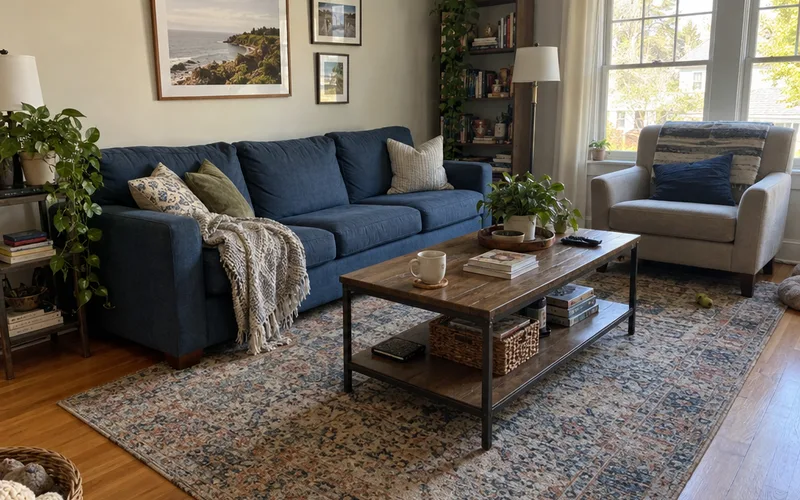
If your chairs sit more than about 7 feet from the sofa front, their legs will miss the rug. That’s your signal to move up a size.
Is a 9x12 Rug Too Big for a Living Room?
No, a 9x12 rug isn’t too big for a living room of about 12x15 feet or larger, because that room still keeps an 18-inch border. The Ruggable guide is more careful and puts it at 12x18 or larger, or in an open floor plan.
Both numbers hold up, and the difference is how much floor you want to show. A 12x15 room gives you 18 inches on every side, while a 12x18 gives you 18 inches on 2 sides and 3 feet on the others.
So when is a 9x12 too big? The math gives you a clear line:
- In an 11x14 room, you get 12 inches on every side, which still works.
- In a 10x13 room, you get 6 inches, and it starts to look like wall-to-wall carpet.
- If it blocks a door or sits under a TV stand on the far wall, it’s too big whatever the room size.
If the border is the problem, step down to an 8x10 and keep the front legs on. If the chairs are the problem, a 9x12 is usually the right call, even in a smaller room.
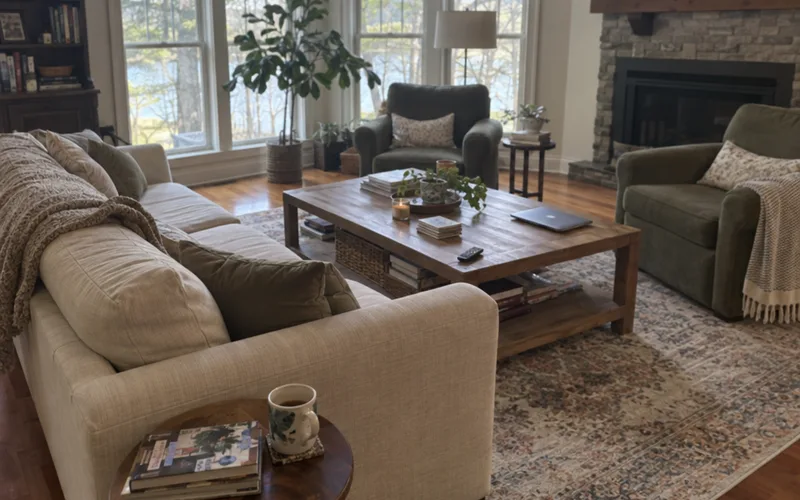
A 9x12 runs 108 by 144 inches, or 108 square feet. That’s 28 square feet more than an 8x10, often enough to get a pair of chairs onto the rug.
Is a 5x7 Rug Too Small for a Living Room?
Yes, a 5x7 rug is too small for most living rooms with a full-size sofa, because it’s only 84 inches long. It works for a loveseat, a very small room or a coffee-table-only layout.
An 84-inch sofa shows the problem. A 5x7 matches it end to end, so nothing shows past the arms and the rug looks like a mat.
A 5x7 fits best when your sofa is 68 inches wide or less. At that width, you still get 8 inches past each end, which suits a loveseat or a small apartment sofa.
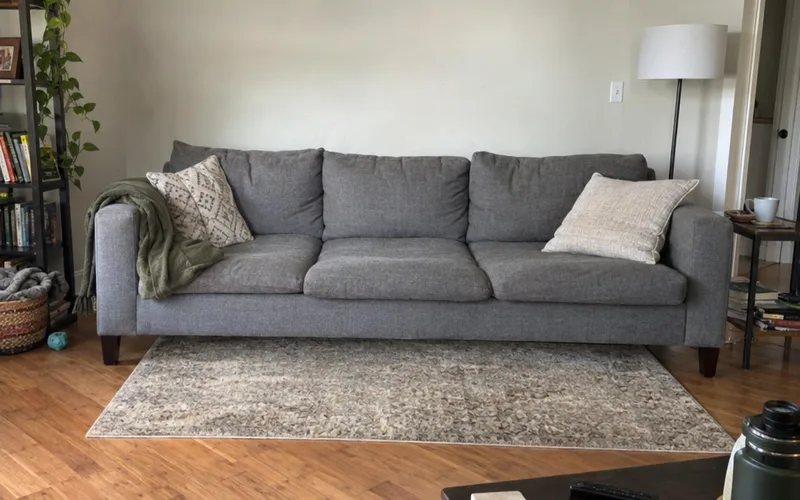
It still has a job as a second rug, set on top of a larger base rug.
What Size Rug for a Small Living Room or Apartment?
A 6x9 rug is the best size for most small living rooms and apartments, and a 5x8 is the fallback when the sofa is under 80 inches wide. The Ruggable guide says a 6x9 or 6.5x9.5 works best in an 11x13 or smaller living room, leaving about 2 feet of flooring on each side.
Small rooms are where people go too small, and that’s the opposite of what the room needs. With all the seats off it, a small rug cuts the floor into pieces, while a larger one makes the floor read as 1 clear space.
Here’s an example. In a 10x12 room with a 76-inch apartment sofa, a 6x9 leaves 2 feet at the short sides and 18 inches at the long sides, and it clears the sofa by 16 inches on each end.
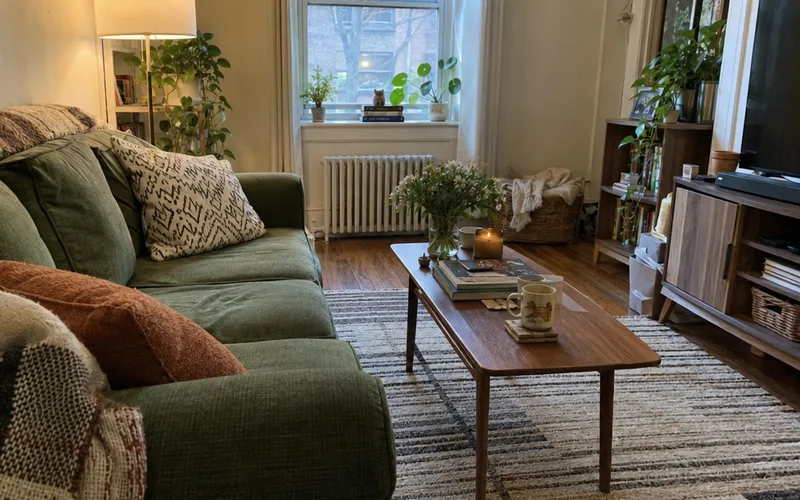
That same room could take an 8x10 with 1 foot all around, which also gets a chair onto the rug.
A rug is also a change you can make without touching a wall, so it’s a natural first step when decorating an apartment living room. On a tight budget, put it near the top of your small room budget ideas.
So measure first, then choose the largest of these sizes that still shows floor on every side. If the room is smaller than about 8x10, a 5x7 under the coffee table is a fair call.
What Size Rug Goes Under a Sectional?
A 9x12 rug is the size I’d start with for an L-shaped sectional in a living room, an 8x10 can work with a small one, and a large or U-shaped sectional usually needs a 10x14. A sectional takes up 2 sides of the rug, so it needs more of it than a sofa does.
The tricky part is the chaise, the long seat that sticks out from 1 end. If the rug stops short of it, the sectional looks lopsided.
Aim to get the front legs of both long sides onto the rug, and let it run past the chaise end by a few inches. Line it up with the inside corner of the sectional instead of centering it on the room.
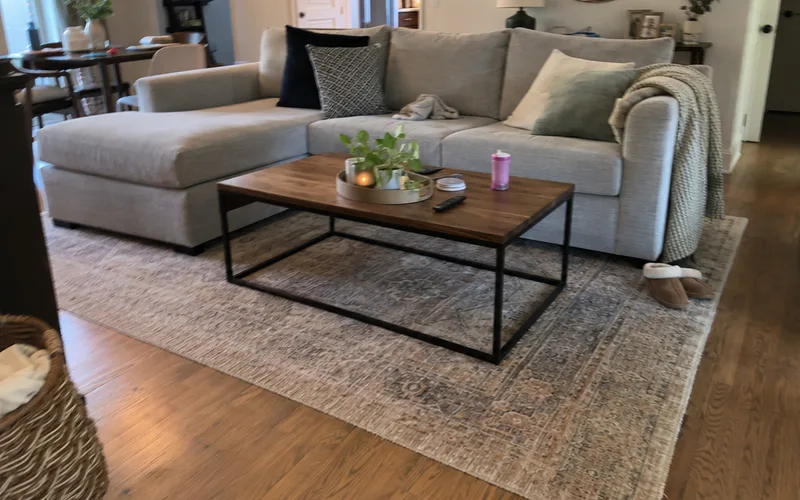
L-shapes, U-shapes and chaise sides each change the math, so sizing a rug for a sectional always starts with its shape.
How Much Bigger Should a Rug Be Than a Sofa?
A living room rug should run past your sofa on both ends, and I’d aim for about 8 inches a side, or 16 inches wider overall. More is fine, but less starts to look tight.
That gives you a simple test for any sofa. Take the long side of the rug in inches, subtract the sofa width, then divide by 2.
An 84-inch sofa gets 12 inches a side on a 6x9, 18 inches on an 8x10 and 30 inches on a 9x12. So if you only care about the sofa, a 6x9 is enough, and anything past that is about the chairs.
Now, which way should the rug run? Point the long side along the sofa in most rooms, because that gives the sofa its full margin.
The exception is a long, narrow room with the sofa on a short wall. There, turning the rug can fill the room better, which is often the fix in a narrow rectangular layout.
How Far Should a Rug Be From the Wall?
A living room rug should sit 12 to 18 inches from the walls in most rooms. The Ruggable guide calls a 12 to 18 inch border of flooring the best layout for a defined living area, and a very small room can go tighter.
The reason is simple: that strip of floor frames the rug. Close the gap too far and it starts to look like carpet that didn’t quite fit.
You don’t need the same number on all 4 walls, but opposite sides should match.
What Is the 18-Inch Rule for Rugs?
The 18-inch rule says to leave about 18 inches of bare floor between the rug and the walls. It’s a rule of thumb for a normal room, and it’s the top of the usual range.
To use it, subtract 3 feet from your room’s length and width, and that’s the largest rug the rule allows. A 14x18 room gives you 11x15, so a 10x14 fits.
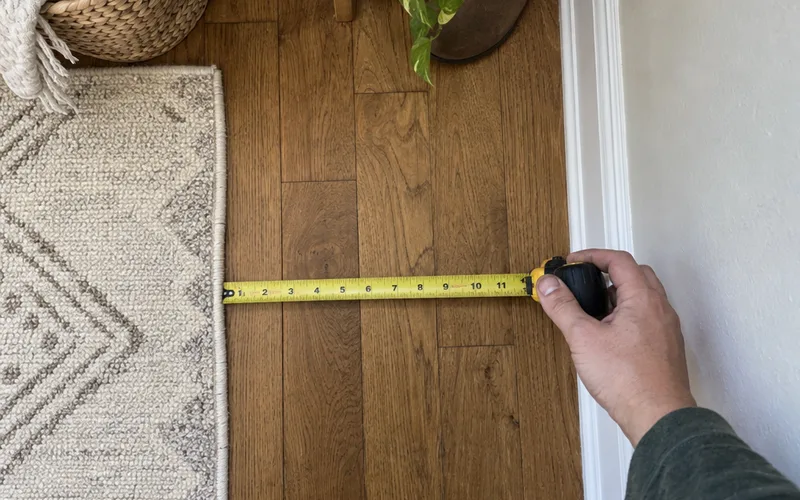
Here’s the part to watch. The same Ruggable guide lists a 10x14 for a room of at least 11.5 x 15.5 feet, with 18 to 36 inches of floor around it, but that room leaves only 9 inches on each side.
To really get 18 inches around a 10x14, you need 13x17. So trust your own subtraction over any chart, including ours.
What Size Rug for a 12x12, 12x15 or 20x20 Living Room?
A 12x12 living room usually takes an 8x10, a 12x15 room takes a 9x12, and a 20x20 room takes a 12x15 sized to the seating group. These 3 rooms show how the math works from small to large.
12x12 Room
An 8x10 leaves 2 feet on the long sides and 1 foot on the short sides, which suits a sofa on 1 wall. A square room can also take an 8x8 or 9x9, which makes a rug for a 12x12 room a closer call than it looks.
12x15 Room
A 9x12 leaves exactly 18 inches on all 4 sides, so this room and this rug are a natural match. Drop to an 8x10 only if your seating group is compact or you want more bare floor.
20x20 Room
The 18-inch rule would allow a 17x17, which isn’t a size you can easily buy. So stop thinking about the walls and size it to the seating group instead.
A 10x14 works for a sofa and 2 chairs, and a 12x15 suits a larger group. In a room this size, 2 rugs that set up 2 seating areas can look better than 1 very big one.
What Size Rug for an Open Floor Plan?
A 9x12 rug is the place to start for an open floor plan living room, and a 10x14 suits a sectional or a large seating group. The Ruggable guide lists both 8x10 and 9x12 rugs for open plans, and with no walls to measure from, the furniture sets the size.
Measure the seating group the usual way, but skip the wall check. Put every front leg on the rug, then let its edge mark where the seating area ends.
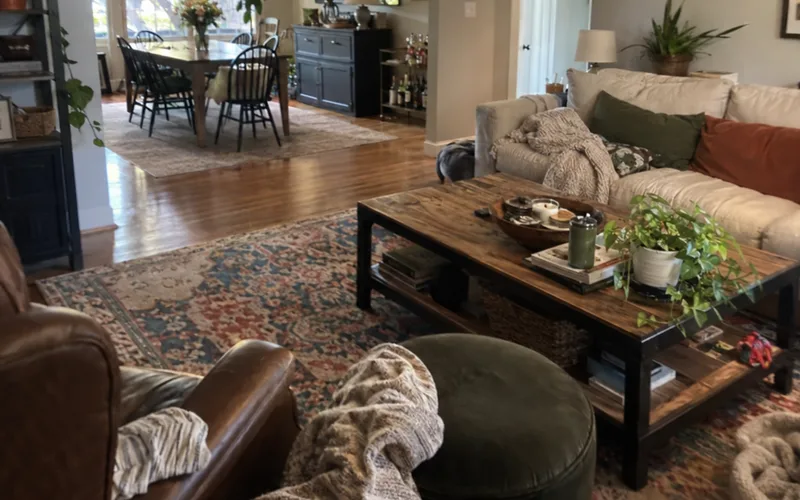
If a dining table shares the space, it needs its own rug, and a dining room rug is sized to the table instead of the sofa.
Keep both the same distance from any walls they share. That way, the 2 areas look like parts of 1 plan, and your whole room layout stays easy to read.
What Shape Rug Works in a Square or Long Narrow Room?
A rectangular rug works in almost every living room, and it’s the safest pick for a long narrow room. In a square room, a square or round rug can work too if the seating group is square or round.
Match the rug to the shape your furniture makes, not the room. A sofa with 2 chairs facing it makes a rectangle, so a rectangular rug still looks right in a square room.
In a long narrow room, run a rectangle lengthwise and keep it clear of the main path. Skip the small round rug here, since it tends to chop the room in 2.
Can You Layer Rugs If the Right Size Costs Too Much?
Yes, layering a smaller rug over a larger, cheaper one is a good way to get the right living room coverage on a budget. The base rug does the sizing job, and the top rug adds the color and pattern.
Here’s what to buy. Pick a plain, flat base in natural jute or woven sisal, which are both plant fibers, in the size your chart says you need.
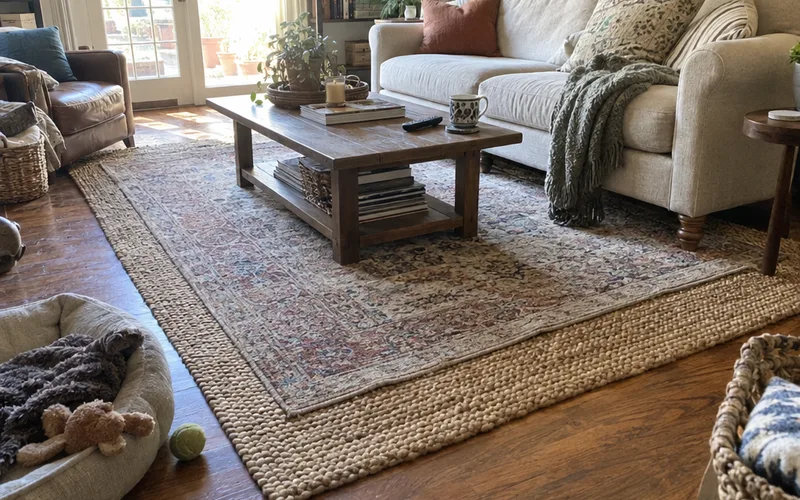
Then set a smaller one on top, centered under the coffee table. Go a clear step down, so a 5x7 suits an 8x10 base and a 6x9 suits a 9x12.
Rugs too close in size look like a mistake, so keep that border clear. And since 2 layers add an edge to trip on, keep the top rug away from your main walking path.
How to Test a Rug Size Before You Buy
The best way to test a rug size is to tape its outline around your furniture with painter’s tape. It takes about 5 minutes, and it can save you from a return on a very heavy box.
Follow these steps:
- Move your seating to where it will really sit.
- Cut 2 pieces of tape to the rug’s length and 2 to its width.
- Tape the outline around the seating group.
- Check that every front leg lands inside the lines.
- Live with it for a day, then walk your usual paths.
Tape 2 sizes if you’re torn, using a different color for each. Most rooms settle the question right there, and if you still can’t decide, go with the bigger one.
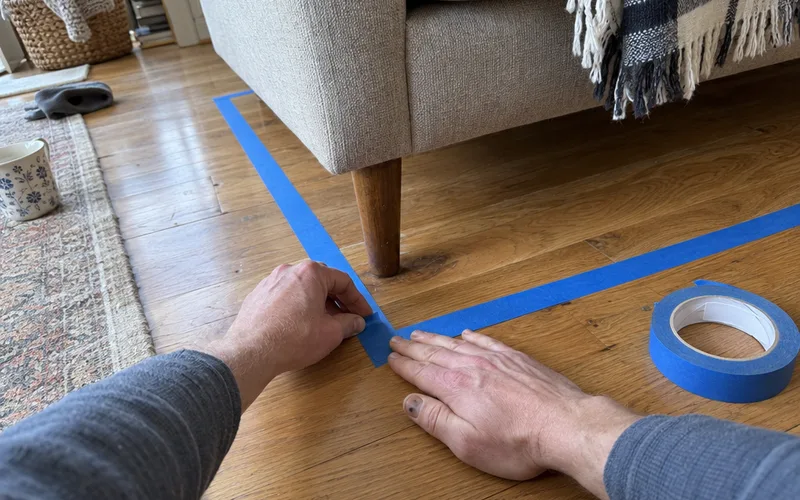
Masking tape works too, but test a small spot first on a delicate floor.
Common Living Room Rug Mistakes
The most common living room rug mistake is buying 1 size too small, which measuring your sofa and walls first will prevent. A few other problems only show up after the rug arrives.
First, check your doors. A thick rug can jam a door that swings over it, so measure the gap under the door before you pick a high pile.
Next, plan for a rug pad. A pad helps stop the rug from sliding, and most of them should be cut slightly smaller than the rug so the edges lie flat.
Finally, read the listing’s exact size, and use those real numbers when you do your math.
Do These Rules Work in a Bedroom or Dining Room?
Yes, the same idea works in a bedroom or dining room, but the anchor piece changes. In a bedroom you size the rug to the bed, and in a dining room you size it to the table and pulled-out chairs.
A bedroom rug follows the bed, so your margin goes on the sides and foot rather than past the sofa arms. Once this rug is sorted, the rest of your living room decor has a base to build on.
Your Next Step
The biggest takeaway? Size the rug to your furniture, and go larger when you’re torn.
Grab a tape measure tonight, write down your sofa width and your room size, and tape out 2 sizes on the floor this week.
Frequently Asked Questions
What is the rule for living room rugs?
The main rule for living room rugs is that at least the front legs of your sofa and main chairs sit on the rug. Then check that the rug runs past both sofa ends and leaves floor showing at the walls.
How big is a 5x7 rug?
A 5x7 rug is 60 by 84 inches, which covers 35 square feet. Measure your sofa against that 84-inch side before you order.
What are the dimensions of a 5x7 rug in centimeters?
A 5x7 rug is about 152 by 213 centimeters. Check the listing for the exact size before you order.
How big is a 10x14 rug?
A 10x14 rug is 120 by 168 inches, or about 305 by 427 centimeters, and it covers 140 square feet. It needs a room of about 13 by 17 feet to keep an 18-inch border.
What size is an 8x10 rug in centimeters?
An 8x10 rug is about 244 by 305 centimeters. That’s 96 by 120 inches, or 80 square feet.
What is the largest rug size for a living room?
The largest rug for a living room is your room size minus 3 feet each way. In a 15x20 room, that’s about 12x17, so a standard 12x15 fits with room to spare.